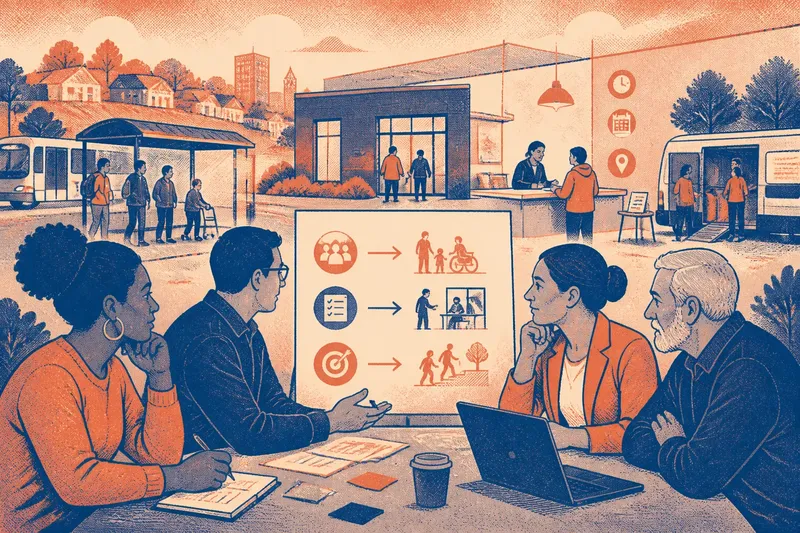
A Policy Announcement Is Not an Implementation Plan
A policy announcement is not an implementation plan. Learn to trace commitments to owners, tasks, handoffs, and decisions that keep delivery moving.
The common mistake is to judge a policy by the force of its announcement. That can cost readers a clear view of whether anyone has translated the promise into work that can be tracked, reviewed, and corrected. A policy announcement versus implementation plan is the difference between a public commitment and an account of how institutions will carry it out.
What does an announcement let the public check?
An announcement states a commitment, intended outcome, or decision. It gives readers a claim they can return to later: what was promised, who made the commitment, and which groups or services it was meant to affect.
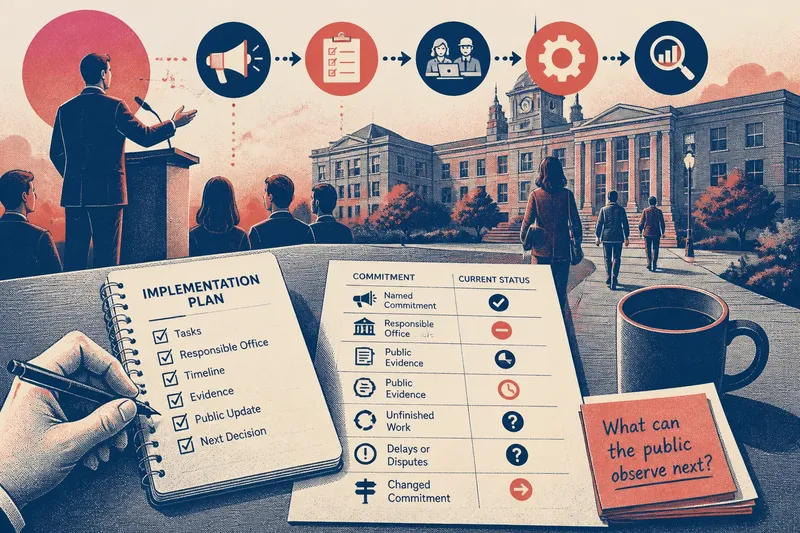
An implementation plan serves a different purpose. It gives the public a way to follow delivery over time: what actions are due, what evidence will show they happened, and who must explain a gap. Look for a public document, progress update, or named contact that makes those links visible.
For example, “expand access to the service” describes an intended outcome. A public account that identifies the tasks, responsible offices, reporting method, and process for correcting delays gives readers a firmer basis for checking progress.
How can you trace a commitment to evidence?
Start with the exact promise, then look for an observable sign of progress. That sign might be a published procedure, a service notice, an updated form, a public report, or an explanation of what remains pending. The appropriate evidence depends on the commitment; a speech alone cannot show that the promised work has been completed.
Use this check to decide what to ask next:
- Named commitment: If the statement names a specific change, then look for a document or public update describing it; if it stays broad, ask what observable change would count as progress.
- Responsible office: If an office is named, then check whether it reports progress; if no office is named, ask which institution answers for the commitment.
- Public evidence: If a record or update is available, then compare it with the promise; if none is available, ask where the public can check progress.
- Unfinished work: If the update identifies an open task, then check whether it names the next decision or action; if it does not, ask who will resolve the gap.
- Delays or disputes: If a problem is reported, then check for a response and a route to escalate it; if no response is described, ask which office handles unresolved issues.
- Changed commitment: If the stated approach has changed, then look for an explanation of what changed and why; if no explanation appears, ask whether the original promise still stands.
These checks do not prove that a policy will succeed. They help distinguish visible activity from a commitment that has not yet been connected to evidence or public accountability.
What should a useful progress update include?
A readable update connects a commitment to completed work, remaining tasks, and the next public sign of progress. It should distinguish what has happened from what is planned, and identify when a decision is still pending without presenting it as settled.
Reports do not need elaborate dashboards to be useful. A short account that names the task, the available evidence, the unresolved issue, and the next responsible office is often easier to assess than a stack of activity summaries. What is not worth the effort is collecting detail that no one uses to explain a decision or change course.
How can you interpret a gap between promise and delivery?
A gap deserves a question, not an automatic verdict. A public update may be late, evidence may be difficult to publish, or work may depend on another decision. Ask what is missing, who can explain it, and whether the commitment has been revised.
Say a fictional city announces that residents will be able to submit one form for several services. In this invented situation, the announcement is public, but the city has not yet posted the form or explained how residents can check its status. A reader looks for a service notice, asks the named city office when the form will be available, and checks the next public update. If the office says the form is still being prepared, the observable result is a clear pending status rather than evidence that the new route is already operating; the reader can then ask when progress will be reported again.
Which questions help assess a policy announcement versus implementation plan?
What is the difference between a promise and evidence of delivery?
A promise describes what an institution intends to do. Evidence of delivery is an observable record or change that can be compared with that commitment.
What should I ask if no progress update is available?
Ask which office is responsible for public updates and where the status will be published. If the commitment has no named owner or reporting route, ask who can answer for it.
Does a delay mean the policy has been abandoned?
Not by itself. Check whether the responsible institution explains the delay, identifies unfinished work, and says how it will report the next decision or change.
How can I tell whether a commitment has changed?
Compare the original wording with later public statements or documents. If the outcome, scope, or timing appears different, ask the responsible institution to explain what changed and whether the original commitment still applies.
What is the next useful question?
After finding a policy announcement versus implementation plan, ask what a member of the public should be able to observe next. The answer might be a published procedure, a progress update, a revised service notice, or a clear explanation that a decision remains pending.
Keep the original commitment and the latest evidence together. That simple record makes it easier to ask a precise follow-up, see whether the explanation addresses the gap, and distinguish a changed promise from work that is still underway.